
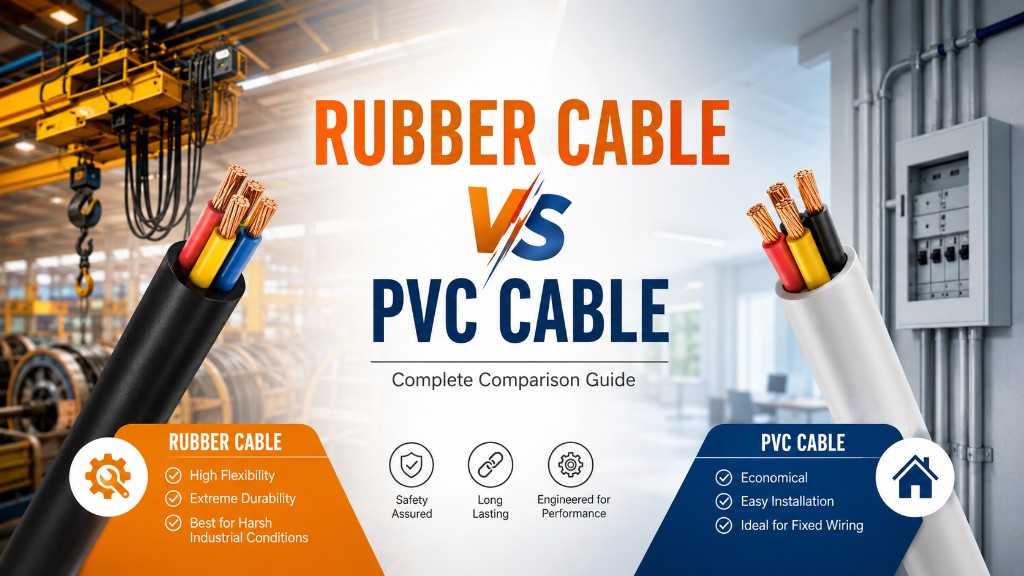
Rubber Cable vs PVC Cable: Complete Comparison Guide | Prestige Cables
Introduction
Rubber Cables outperform PVC Cables in harsh industrial conditions where flexibility, abrasion resistance, and mechanical durability are essential. They are commonly used in cranes, mining, windmills, heavy machinery, and mobile equipment. PVC Cables are better suited for fixed wiring, electrical distribution, and commercial or residential installations due to their affordability and ease of installation. If continuous movement and extreme environments are involved, Rubber Cable is the preferred solution. For standard low-voltage installations with limited mechanical stress, PVC Cable offers excellent value.
Quick Comparison Table
| Feature | Rubber Cable | PVC Cable |
|---|---|---|
| Purpose | Heavy-duty industrial power transmission | Fixed electrical wiring |
| Construction | Elastomeric insulation and sheath | PVC insulation and sheath |
| Conductor | Copper | Copper or Aluminium |
| Insulation | Rubber compounds | PVC Compound |
| Voltage Rating | 300/500V to 11kV | 300/500V to 1.1kV |
| Fire Resistance | Good with specialized compounds | Available in FR/FRLS variants |
| Flexibility | Excellent | Moderate |
| Durability | Very High | Good |
| Mechanical Resistance | Excellent | Moderate |
| Moisture Resistance | Excellent | Good |
| Chemical Resistance | High | Moderate |
| Best For | Mining, cranes, heavy industries | Homes, offices, commercial buildings |
What is Rubber Cable?
A Rubber Cable is a flexible power cable manufactured using elastomeric insulation compounds that provide superior mechanical strength and flexibility. Unlike rigid cables, rubber-insulated cables are designed to bend repeatedly without damaging the conductor or insulation.
Prestige Cables manufactures several specialized rubber cable variants, including:
- Rubber Training Cables
- Elastomeric Cables
- EPS/PLP/CSP Cable
- Silicon Cable
- VIR/TRS Cable
- Rubber Mining Cable
- FT-7 Cable
- FTD-3 Drill Cable
- Windmill Cable
- Crane Cable
- EOT Crane Cable
- CRD Cable
- Stacker Reclaimer Cable
These cables are widely used in industries where cables experience continuous movement, vibration, oil exposure, moisture, and mechanical stress.
What is PVC Cable?
A PVC Cable, also known as a PVC Insulated Cable or Polyvinyl Chloride Cable, uses PVC as its primary insulation and outer sheath material. PVC offers good electrical insulation, moisture resistance, and affordability, making it one of the most widely used cable materials worldwide.
PVC cables are commonly installed in:
- Residential buildings
- Commercial complexes
- Offices
- Control panels
- Distribution boards
- Lighting circuits
- Power distribution systems
They perform best in fixed installations where flexibility is not the primary requirement.
Rubber Cable vs PVC Cable – Detailed Comparison
Construction
Rubber Cables use elastomeric compounds specifically designed to withstand bending, twisting, impact, and harsh environmental conditions. Their flexible insulation minimizes the risk of cracking during repeated movement.
PVC Cables use thermoplastic PVC insulation, providing reliable electrical insulation for fixed wiring while maintaining cost efficiency.
Winner: Rubber Cable for industrial durability.
Performance
Rubber Cables maintain electrical performance even under continuous flexing, vibration, oil exposure, and outdoor conditions. They also perform well across a wider temperature range.
PVC Cables provide dependable electrical performance under normal operating conditions but are less suitable for repeated movement or severe mechanical stress.
Winner: Rubber Cable.
Fire & Safety
Modern PVC Cables are available in Flame Retardant (FR), Flame Retardant Low Smoke (FRLS), and Low Smoke Zero Halogen (LSZH) variants, making them suitable for buildings where fire safety is a priority.
Rubber Cables also offer fire-resistant options depending on compound selection, but their primary strength lies in mechanical durability rather than building fire protection.
Winner: Depends on application.
Cost of Rubber cable and PVC Cable
PVC Cables generally have a lower initial purchase cost because PVC insulation is economical and manufacturing is simpler.
Rubber Cables involve higher production costs due to premium elastomeric compounds and specialized construction.
However, in demanding environments, Rubber Cables often deliver lower lifecycle costs because they require fewer replacements and less maintenance.
Advantages of Rubber cable and PVC Cable
Rubber Cable Advantages
- Outstanding flexibility
- Excellent mechanical strength
- Superior abrasion resistance
- Oil and chemical resistance
- Suitable for moving machinery
- Wide voltage range
- Long service life
- Excellent outdoor performance
PVC Cable Advantages
- Economical
- Easy installation
- Good electrical insulation
- Lightweight
- Widely available
- Suitable for fixed wiring
- Low maintenance
Limitations of Rubber cable and PVC Cable
Rubber Cable
- Higher purchase cost
- Heavier than PVC
- Not necessary for simple building wiring
PVC Cable
- Lower flexibility
- Limited performance under continuous movement
- Reduced resistance to severe industrial conditions
- Shorter lifespan in high-stress environments
Which Product Should You Choose between of Rubber cable and PVC Cable?
Home Wiring
PVC Cable is generally the preferred choice because it offers reliable electrical insulation, affordability, and easy installation for fixed electrical circuits.
Commercial Buildings
PVC Insulated Cables are suitable for lighting, distribution, and general electrical infrastructure, especially where cables remain stationary.
Industrial Projects
Rubber Cable is the better option due to its superior flexibility, mechanical strength, and ability to withstand harsh industrial environments.
Budget-Friendly Option
PVC Cable provides the lowest initial investment while delivering dependable performance for standard installations.
Maximum Safety
For heavy-duty industrial equipment exposed to vibration, movement, oil, and moisture, Rubber Cable provides greater operational reliability and longer service life. For building fire safety, appropriately rated FR or FRLS PVC Cables may be preferred depending on project requirements.
Long-Term Performance
Rubber Cable generally delivers better long-term performance in demanding applications because of its resistance to wear, impact, and environmental stress.
Why Choose Prestige Cables?
Prestige Cables is a trusted Indian manufacturer of industrial and specialty cables, delivering reliable solutions for diverse electrical applications. The company manufactures a broad range of rubber cable products designed to meet demanding industrial requirements.
Prestige Cables offers:
- Extensive range of Rubber Cables
- Elastomeric cable solutions
- Crane and EOT Crane Cables
- Rubber Mining Cables
- Windmill Cables
- Silicon Cables
- FT-7 and FTD-3 Drill Cables
- CRD and Stacker Reclaimer Cables
- High-quality manufacturing processes
- Comprehensive quality testing
- Compliance with relevant industry standards
- Strong customer support and technical expertise
- Reliable supply for domestic and export markets as an experienced Exporter of Rubber Cable
Frequently Asked Questions (FAQs)
Rubber Cable is significantly more flexible and is specifically designed for applications involving continuous movement and bending.
They can be used, but PVC Cables are generally more practical and economical for standard residential wiring.
Rubber Cables typically offer a longer service life because they better resist abrasion, impact, oil, moisture, and repeated flexing.
PVC Cables have good moisture resistance, but Rubber Cables generally provide better protection in harsh outdoor and industrial environments.
Crane Cables and EOT Crane Cables are specialized Rubber Cables designed for continuous movement and mechanical stress.
Yes. Rubber Mining Cables are specially designed to withstand the severe mechanical and environmental conditions found in mining operations.
PVC Cable has a lower initial purchase cost, making it a budget-friendly choice for fixed installations.
PVC Cable is generally not recommended for continuous flexing or moving equipment. Rubber Cable is better suited for these applications.
Rubber Cable provides superior resistance to oil, grease, chemicals, and mechanical wear compared with standard PVC Cable.
Rubber Cables are available in a wider voltage range, extending into medium-voltage applications up to 11kV, whereas standard PVC Cables are typically used up to 1.1kV.